
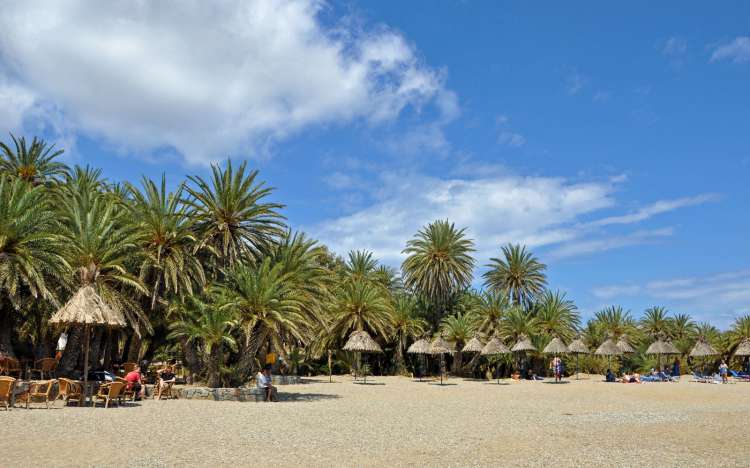
 Discovering Vai: Crete’s Unique Palm Forest
Vai, located in eastern Crete, is home to the largest natural palm forest in Europe and the only grove of Cretan date palms in the world. This remarkable forest sits alongside a river that flows from Alopatelos Hill. While the river dries up in the summer, it floods the Vai plain during winter and spring. The river meets the sea near a stunning white sand beach, where the palms grow right by the shore, creating a landscape that feels more Caribbean than Cretan.
A Caribbean-Like Paradise in Crete
Standing on the bright, soft sands of Vai Beach, you might feel like you’ve been transported to the Caribbean or Africa, but this is undeniably Crete. The palms here are unique to the island, a fact first documented by Theophrastus, an ancient Greek philosopher and naturalist, who followed Aristotle and wrote extensively about plants in his work “Historia Plantarum.”
Legends Surrounding Vai
Two legends explain the origins of the Vai palm forest. One suggests that Saracen pirates from Africa, who settled here for a time, ate dates and scattered the seeds, which grew into the vast palm forest. The other legend claims that Phoenicians traveling from east to west spread the date seeds. Historians and botanists favor the latter, noting that the Vai palm forest is over 2000 years old, while the Saracens only appeared in the Mediterranean during the Middle Ages. Furthermore, the name “Phoenicia” itself means “land of palms” in Greek.
Vai’s Rise to Fame
Vai remained relatively unknown until the 1970s when a famous “Bounty” chocolate bar commercial was filmed there. The commercial’s producers saved on travel expenses by attaching coconuts to the Vai palms instead of flying to the Caribbean. The advertisement popularized the beach to the extent that it became known as “Bounty Beach.” Although this name has faded, the original name, Vai, is now well-known among visitors to Crete.
Protecting Vai’s Fragile Ecology
The name “Vai” comes from the ancient Egyptian word for palm branch. After the hippies, who were evicted from Matala, settled in Vai, the area became a popular spot for camper van travelers in the 1980s and 1990s. However, the waste left by visitors nearly destroyed the delicate ecosystem. To protect it, the Orthodox Church declared Vai a protected area. Now, no one is allowed to stay overnight on the beach, which remains under the ownership of the powerful Toplou Monastery.
Today, about 5000 trees grow in Vai’s palm forest, all near the river from Alopatelos Hill. The palms, thriving by the sea, create a landscape more reminiscent of the Caribbean than Crete, making Vai one of the island’s most popular beaches.
Accommodation and Travel to Vai
Camping and setting up tents on the beach or in the palm forest is prohibited. However, there are nearby hotels, or you can stay at the nearby Psili Amos Beach, favored by nudists, where overnight stays are allowed. Waking up early at Vai offers a chance to see the sunrise over the sea, illuminating the palm forest and empty beach with golden morning light.
Getting to Vai
Vai Beach is easily accessible via a well-maintained asphalt road. However, the journey from major Cretan resorts is long due to the winding roads, with an average speed of 40-50 km/h. Therefore, I recommend visiting Vai only if you’re staying east of Crete’s capital, Heraklion. For example, the trip from Kokini Hani or Gouves takes about 3.5 hours one way, from Hersonissos or Stalida about 3 hours, from Malia or Sisi about 2.5 hours, and from Elounda or Agios Nikolaos about 2 hours. Traveling from resorts near Rethymno or Chania is not advisable due to the long travel time. Consider if you want to spend 6-8 hours traveling just to swim at Vai Beach.