
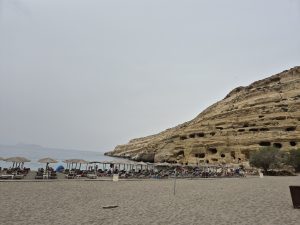
Thousands of tourists visit this southern Crete beach each year knowing just one thing: Matala is the legendary hippie paradise where an annual festival promotes peace and spiritual freedom. However, Matala village, its caves, and beach have stories that extend far beyond the hippie era.
Matala Myths
According to ancient Greek mythology, the god Zeus, transformed into a white bull, brought the beautiful Phoenician princess Europa across the sea to Matala beach. Here, he turned into an eagle and carried Europa to a love nest in nearby Gortyn. Scholars of the “Odyssey” assert that the Spartan king Menelaus and his beloved Helen also visited Matala while returning from the Trojan War.
Matala Beach
Framed by rocky shores, Matala beach forms a secluded bay offering a stunning view of the twin Paximadia islets in the distance. The crystal-clear water laps against the shore, washing over sand mixed with fine gravel that pleasantly crunches underfoot.
Facing west, Matala experiences waves due to prevailing westerly winds, enhancing the appeal of its beautiful 300-meter-long sandy beach. You can spend hours in the nearby taverns, enjoying the mesmerizing waves.
You can also explore the caves carved into the northern cliffs framing the beach. One spot on the cliffs is popular for cliff diving. The beach itself deepens quickly, but the central area has rocks, so caution is advised when swimming further from the shore.
Amenities
Matala offers ample comfort. During the holiday season, the beach provides sunbed and umbrella rentals, showers, restrooms, a beach volleyball court, and various water activities. Lifeguards are on duty, and first aid is available. The beach is accessible for people with disabilities.
Due to its amenities and upkeep, Matala beach consistently earns the “Blue Flag” award, recognizing it as one of the best beaches in Crete.
Caves
The caves in Matala’s cliffs were carved during the Stone Age, around 9000 BC, when people lived in them. During the Roman Empire and the early years of Christianity, the caves were used as tombs. After being abandoned for centuries, hippies repurposed them as dwellings in the 1960s.
Matala Settlement
For over a thousand years, from the 6th century BC to the 7th century AD, a city known to historians as Matelon flourished near Matala beach. Its ruins were first discovered during archaeological excavations in the 1980s, with many ancient buildings found underwater near the beach.
Festos Palace Port
Historians speculate that 4000 years ago, during the Minoan civilization, Matala beach served as the main port for the Festos Palace. Later, during the city’s heyday, the Romans used the port to travel to Gortyn, Crete’s then-capital. In 824 AD, the Arabs began their conquest of Crete from this port. Over time, Matala transformed into a small fishing village.