
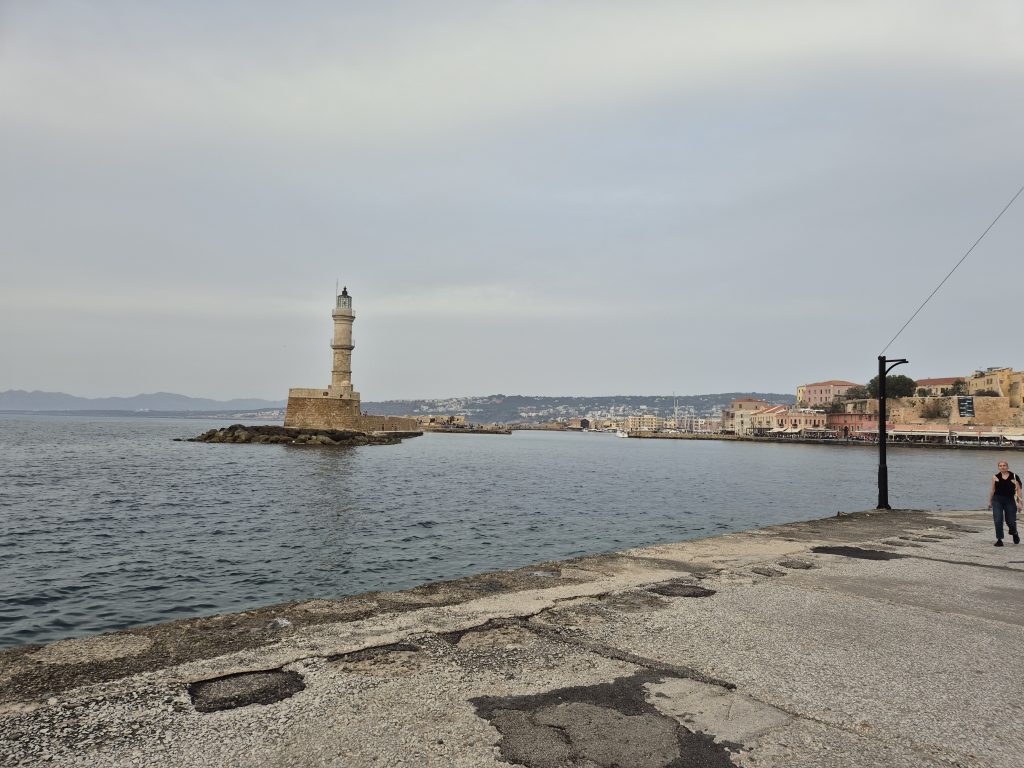
Chania, often referred to as the Venice of Crete, may not have canals, but it boasts stunning Venetian architecture, a testament to its rich history. Despite enduring wars and uprisings, the city has preserved its enchanting old port, symbolized by the iconic lighthouse. Beyond its architecture, Chania envelops every visitor with a magical and cozy atmosphere.
Historical Background
From 1209 to 1669, Crete was under Venetian rule, which is why many of Chania’s streets and alleys remain almost unchanged from 400, 600, or even 700 years ago. In the eastern part of the old town, one can see the ruins of a Byzantine fortress, revealing a deeper history. Archaeologists have found that this fortress was built on foundations dating back to the Bronze Age. During the Minoan civilization, the area where Chania now stands was a thriving settlement known as Kydonia in ancient Greek texts.
Old Town Attractions
The old town of Chania is a vibrant area filled with cafes, taverns, shops, and artisan workshops. Walking through its streets, one can always discover something new. Key attractions include:
The Old Port and Venetian Lighthouse
The old port is the pride of Chania and the best place to start exploring this remarkable city. Walking around the port to the Venetian lighthouse, built in the late 16th century, is highly recommended. Originally, it served both as a guide for incoming ships and as a fortified entrance to the harbor. During the Ottoman occupation, the lighthouse was transformed into a minaret and called the Egyptian Lighthouse. It suffered damage during World War II but was fully restored in 2005.
Firka Fortress and Maritime Museum
Located at the western end of the old port, Firka Fortress is a well-preserved part of the Venetian defensive walls, built to protect the city from pirates and later from the Ottomans. In 1645, the fortress was converted into barracks and a prison after the Ottomans captured Chania. Today, the Maritime Museum occupies part of the fortress, displaying over 2,500 exhibits, including maps, paintings, photographs, ship models, and nautical objects. Visitors can also enjoy a panoramic view of the old port from the fortress walls.
Küçük Hasan Pasha Mosque
Also known as the Janissaries Mosque, it was built on the ruins of a Christian church with funds from Ottoman soldiers (Janissaries). The mosque was dedicated to the first commander of the Chania garrison, Küçük Hasan Pasha. Locals often refer to it as “Yiali Tzami” (Seaside Mosque) due to its proximity to the water. Although it ceased to function as a mosque in 1923 and its minaret was demolished in 1939, the building is still used for public exhibitions and events.
Orthodox Chania: The Cathedral of the Virgin Mary
The largest and most important Greek Orthodox church in Chania, the Cathedral of the Virgin Mary, was completed in 1860 while Crete was still under Ottoman rule. Built on the site of a 14th-century church that had been converted into a soap factory by the Ottomans, the new church was funded by a local Pasha following a miraculous event involving his son. The cathedral stands as a symbol of the city’s religious and cultural resilience.
Catholic Chania and the Museum of Cretan Life
Opposite the Chania Cathedral, through a secluded courtyard, lies one of the three Catholic churches of Crete, built in 1879 on the site of a Capuchin monastery established in 1566. Adjacent to the church is the Museum of Cretan Life, founded by two local women to teach traditional crafts. The museum features a rich collection of household items, with a notable selection of textiles and embroidery from across Crete.
Additional Highlights
Chania Archaeological Museum
Housed in a former Venetian monastery of St. Francis since 1963, the museum’s exhibits offer insights into ancient Crete. Artifacts from the Greek and Roman periods, as well as items from the Neolithic and Bronze Ages, are on display, illustrating Chania’s long and diverse history.
Ahmet Aga Minaret and Tavern Street
One of Chania’s two surviving minarets, located on Hatzimichali Daliani Street, stands as a remnant of a mosque now used as a theater and concert hall. This street is popular with locals for its numerous taverns and restaurants, renowned for their inventive menus.
Agora – The Old Market
A cross-shaped covered market open from morning until afternoon, except on Sundays. Both locals and tourists visit to buy various Cretan products, such as olive oil, honey, herbal teas, spices, and natural cosmetics. Currently, the market is under renovation and is expected to reopen by the end of 2024.
Skridlof Leather Street
Traditionally home to leather workshops and stores, Skridlof Street still features craftsmen making traditional Cretan boots, known as ‘stivania.’ Although the street has evolved over time, it remains a go-to destination for high-quality leather goods, including shoes, bags, wallets, belts, and accessories.
Chania, with its blend of Venetian, Byzantine, and Ottoman influences, offers a unique historical and cultural experience for every visitor.