
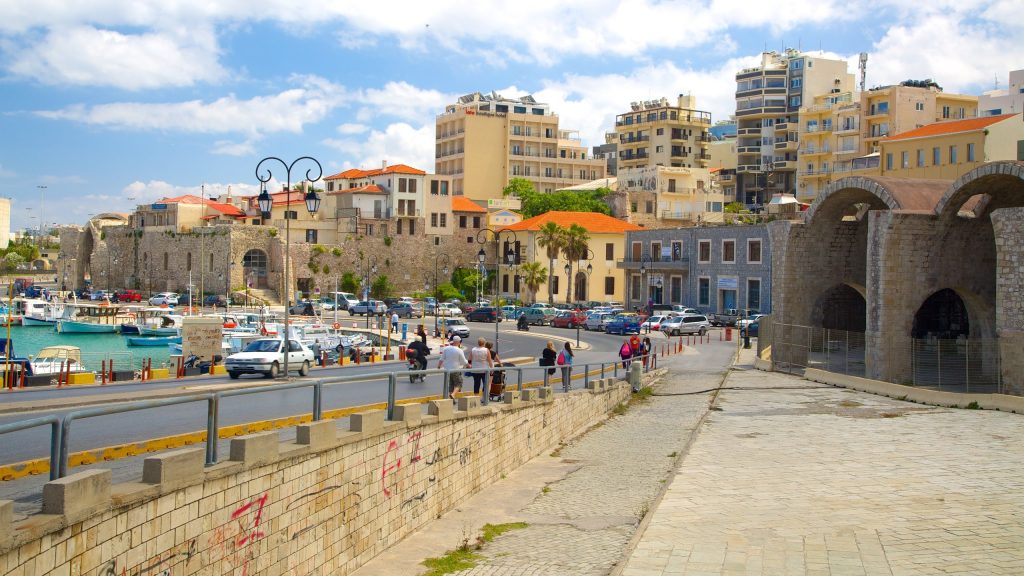
Heraklion, the largest city in Crete and a prominent urban hub of Greece, boasts a rich history shaped by diverse influences over the centuries. Standing as a testament to its captivating past are the city’s impressive landmarks, with the 16th-century Koules fortress taking center stage in the western side of the old Venetian port. The fortress, along with its formidable fortification walls, stands as a remarkable sight and a reminder of the city’s historical significance.
Begin your journey in Heraklion at the old Venetian port, where the vaulted tarsanades (shipyard) harken back to the Middle Ages when ships were crafted with skill. Dominating the port’s western edge, the Koules Fortress, initially built by the Arabs and later reinforced by the Venetians, exudes an aura of strength and grandeur. The Martinengo bastion, among the seven that once stood, now hosts the final resting place of the renowned writer, N. Kazantzakis, offering a mesmerizing view of the city. Two of the city’s original four entrances remain, the Chanioporta (1570) Gate, adorned with a marble relief winged Lion of Saint Marc, and the New Gate (1587) on the southern side of the fortress.
Within the heart of Heraklion, the echoes of the Middle Ages reverberate through a multitude of monuments that celebrate the city’s prosperity during that era. Following 25 Avgoustou (August) street from the port will lead you to the public square, where the church of Agios Titos stands tall, constructed in 1872 atop the site of a Byzantine church. Adjacent to it, the 16th-century Venetian Loggia, adorned with ornate arcades and sculptures, once served as a meeting place for noblemen during the Venetian rule.
As you explore the city, you’ll encounter a series of captivating Venetian and Turkish fountains, each with its own unique charm. The Morozini fountain, affectionately known as the Lions fountain (1628), remains an iconic landmark adored by both locals and visitors alike. Other noteworthy Venetian fountains, such as the Bembo fountain (1552-1554) on Kornaros Square, the Sagredo fountain (1602-1604) near the Loggia building, and the Priuli fountain (1666) close to the port, also grace the city. Among the intriguing Turkish fountains are the Philanthropic fountain (1776) on Kornarou Square, operating as a coffeehouse these days, and the Idomeneas fountain, Genitsar Aga Fountain, and more scattered across the city.
Heraklion’s impressive churches stand as architectural marvels, with the imposing Metropolis of Agios Minas taking prominence on Agia Ekaterini Square. This magnificent structure, built between 1862-1895, is complemented by the chapel of Mikros Agios Minas nearby and the 16th-century church of Agia Ekaterini on the northeast, housing fascinating exhibits from the Cretan Renaissance. The presence of Agios Markos (13th century) commands attention in Venizelou Square, while other significant churches such as Panagia Akrotiriani, Panagia ton Stavroforon, and the Monastery of Agios Petros and Pavlos add to the city’s spiritual allure.
Lastly, the food market of Heraklion promises a delightful sensory experience, featuring an array of products and traditional Cretan delights like the famous Cretan olive oil, raki, local wine, honey, and aromatic herbs. Don’t miss the opportunity to take a piece of Crete back home with you as a cherished souvenir!
In Heraklion, the past and present intertwine harmoniously, inviting you to explore its vibrant tapestry of history, culture, and flavors. Immerse yourself in the multifaceted allure of this multicultural gem and let Heraklion leave an indelible mark on your heart.